Key Decision
After we have decided on our long-term goals and savings ratio practical to our situation, the next decision is how to invest the money. How we invest is the most crucial decision – as decides the growth of our money and in staying the course of our investment journey.
Equity Debt Ratio
The primary job of the GrowSuperRich team is in helping the investor find an appropriate portfolio to meet their short term and long-term goals. As we have seen in other writings on savings ratio and time in market , our financial goals are short-term (5-7 years) or long-term (>7 years).
Debt investments form the core part of short-term goals. Equity based investments are key for generating inflation beating returns over the long term. Hence the key decision is to get the Equity to Debt ratio correct to match the short term and long-term goals.
Risk Appetite
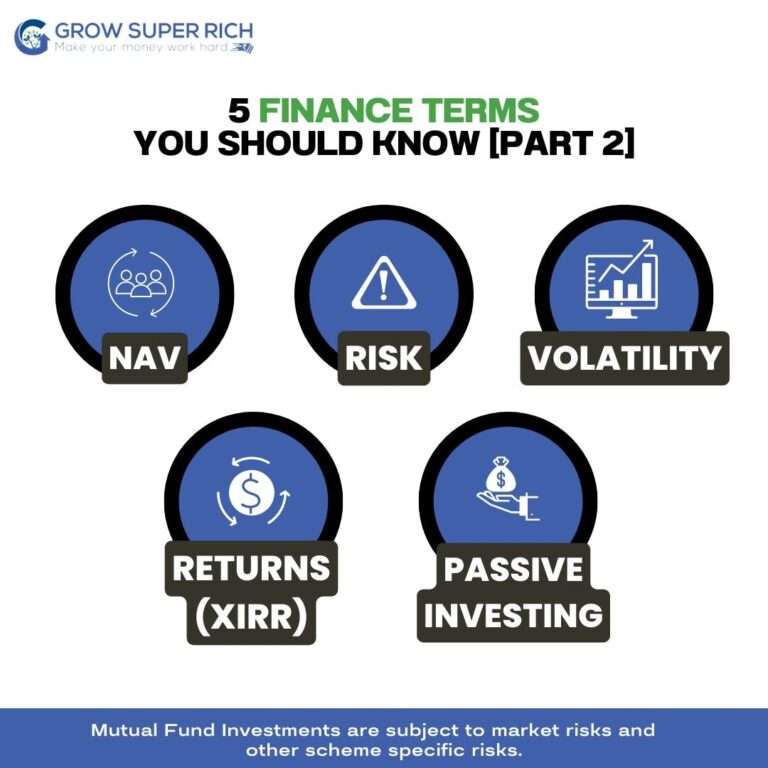
The second major factor deciding the characteristics of a portfolio is investor risk appetite. One of the general accepted definitions of risk is volatility. Volatility or price fluctuations of a portfolio is dominated by equity as they can go anywhere between -50% to 100% in shorter time frames and drops of 10-20% is routine. A 100% equity portfolio will have a very high volatility which most investors will find hard to stomach. The lows could sometimes be less than invested value. Debt on the other hand is a staid and steady component of Portfolio, not growing dramatically nor plunging to great depths.
Equity Level and Risk
Debt stabilizes the returns of equity due to it being less volatile and providing portfolio diversification. The level of risk appetite (or volatility) that one can stomach is a key determinant in the amount of equity one can take. A Equity: Debt Ratio that one is comfortable in long run through the ups and downs of market is a better choice than an overly aggressive equity allocation. Once a specific allocation is chosen and the long-term risk associated with that is accepted it is better to stick to that through different periods of ups and downs of the market. The downs of the market are a very good time to assess one’s true risk appetite.
Draw down Appetite
One simple way to assess the level of equity in a portfolio is to ask what the maximum extent of portfolio draw down is one willing to take at any point in time. As a general thumb rule one can expect a 40-50% draw down in equity once in a decade and so it is not uncommon to expect this in one’s investment journey at least 4-5 times. However, it is difficult to predict how one will react to that. One key question to ask is what the level of draw down in a portfolio one is willing to take before panicking. This is a key barometer of your equity portfolio risk appetite.
If one cannot stand more than 20% draw down in your journey, then as a thumb rule you might not want to go more than 40% in equity. Although equity is mean reverting (that is every drawdown is followed by a bounce back), and we might take long-term orientation it is psychologically difficult to handle big losses and major decisions like selling equity and making losses becomes possible. Deciding the extent of equity in the portfolio which will not let us panic is crucial to understand before the draw downs.
Portfolio Risk Anchor
Portfolio allocation ratio is the risk anchor for you. Portfolio allocation helps you steer through various market movements as your allocation of risk allows for you to take the profits and volatility associated with that risk.
This allows you through a process of re-balancing to keep your risk levels consistent all through your investment journey. In the process of maintaining your proportional allocations of equity and debt all through the market cycle of ups and downs – you primarily do the buy Low and sell high as you sell the asset class that has appreciated and buy the one that is lower and, in the process, stay consistent with your original risk decision.
A perfect Equity-Debt ratio is the point where you sleep peacefully through market downturns and gives you comfort by participating in market rallies. Too much on either side will be a challenge to maintain as anchor and is an indicator to revise allocation. Market downturns are a good time to truly assess one’s risk appetite and anchor point of Equity-Debt ratio.
Summary
- Allocation to equity and debt is the single most important decision in a Portfolio
- Debt is the core anchor of the portfolio which allows for dampening the volatility of equity and diversifying your portfolio.
- Risk Appetite or extent of volatility and draw down one can withstand is a key input in deciding how much equity can be in portfolio.